

How Does a Butterfly Valve Work?
Butterfly valves work by turning a quarter, often used for on-off or modulating services. They are available with huge orifice diameters, are lightweight, only need a little space for installation, are less expensive, and operate quickly. A disk is attached to a rod to create the “butterfly”. The disk spins to allow fluid to flow through when the valve opens. When the rod quarter-turns the disc to a position perpendicular to the flow direction, it closes.
Let us find out more about these valves’ operation and when to apply them in various situations.
Butterfly valve working principle
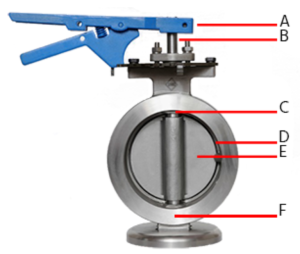
The design of butterfly valves is rather straightforward. The body, seal, disc, and stem are the four primary parts of a butterfly valve, as shown in the figure below. A butterfly valve’s disc (marked as E) lines up with the center of the piping it is linked to, and the stem (marked as B), which links to an actuator or handle on the valve’s exterior. As shown in the figure below, when the valve is closed, the disc is parallel to the flow and seals against the valve seat (marked as D).
The stem packing’s o-ring (marked as C) prevents leakage down the stem. The disc likewise rotates 90 degrees to become parallel to the flow when the actuator or handle turns the butterfly valve stem 90 degrees. The flow can be proportionally or throttled with partial rotation.
Various butterfly valve types
Different butterfly valve designs are available, each of which serves particular uses and pressure ranges. Based on its connection design, disc closure design, and actuation technology, valves can be divided into different groups.
Disc closure design
Depending on where the stem sits in reference to the disc’s centerline and the surface angle of the valve seat, butterfly valves can be either concentric or eccentric.
Concentric: Centric or concentric type valves are the most fundamental kind of butterfly valves. The seat is the inside diameter of the valve body’s periphery, and the stem runs through the disc’s midline. Resilient-seated refers to this zero-offset valve’s design because effective sealing depends on the rubber seat’s flexibility. At about 85° of a 90° revolution, the disc first makes contact with the seat during closing. Low-pressure ranges are appropriate for concentric type valves.
Eccentric: The stem of an eccentric type valve is positioned behind the disc’s centerline rather than through it (opposite of flow direction). The stem of a single offset butterfly valve is behind the centerline of the disc. The amount of contact surfaces between the disc and seal before the valve fully closes is decreased by this design. Less contact lengthens the valve’s useful life.
A double offset or doubly eccentric butterfly valve has a stem that is offset to one side in addition to being behind the disc’s centerline. Due to the twofold eccentricity of the stem, only the final 1-3° of disc closure are in contact with the seat.
High-performance butterfly valves utilize the pipeline’s pressure to improve the seal between the disc’s edge and the seat. These butterfly valves can withstand greater pressures and are less likely to wear out.
Connection design
Butterfly valves can be linked to a piping system in a variety of ways. Wafer, flange, and lug type connections are the most common.
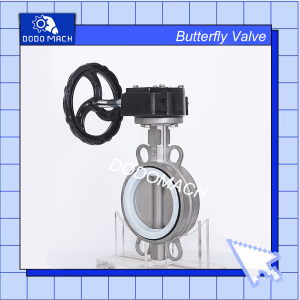
Wafer type: A wafer type butterfly valve sandwiched between two pipe flanges is the most cost-effective version. The pipe flanges are connected by long bolts that span the entire valve body. This connection type is appropriate for sealing against bi-directional differential pressure and preventing backflow in universal flow systems. Some models of the valve have flange holes on the outside of the valve body. To achieve efficient sealing, gaskets, o-rings, and flat valve faces on both sides of the valve work together.
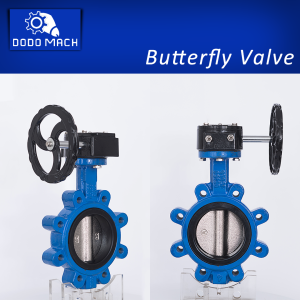
Lug type: Outside the valve body are threaded inserts (lugs) on the lug type valve. Pipe flanges are connected to each side of the bolt inserts by two sets of bolts without nuts. This design allows one side to be disconnected without affecting the other’s function for dead-end service. In general, lug type butterfly valves used in dead-end service have a lower pressure rating. Moreover, unlike wafer type valves, lug type valves support the piping through the valve body.
At the end, if you have any question about our pneumatic products, just feel free to contact us for more information.
You can view and learn more about our products through our official website.