
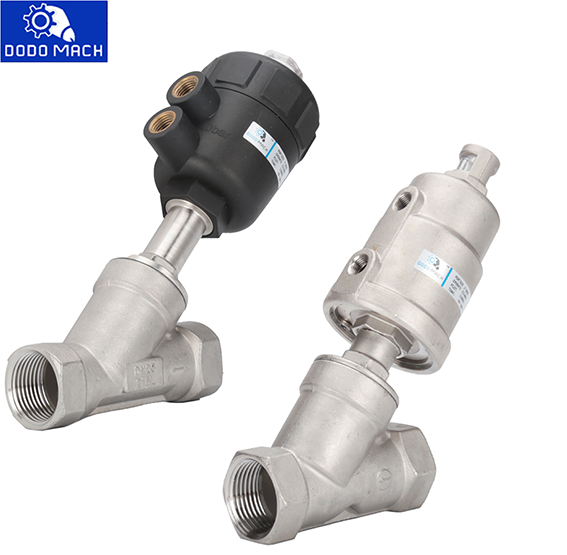
Angle seat valves can accurately regulate the flow of a wide range of media due to their unique angle seat structure, which significantly reduces flow resistance and pressure loss. The valve is known for its excellent durability and long service life, even at high temperatures, high-viscosity media, and other harsh conditions, it still maintains excellent performance, compared to ball valves and solenoid valves, angle seat valves offer more advantages. Angle seat valves support a variety of manual, pneumatic and electric drive.
Construction and design
Manual angle seat valve
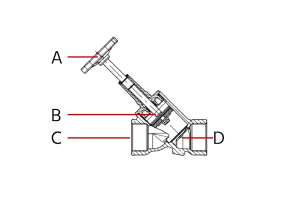
Figure 1: Diagram of a manual angle seat valve with components: handwheel (A), plug/disc (B), connecting port (C), angled valve seat (D).
The key components (Figure 1) of an angle seat valve are as follows:
Handwheel (A): Used to manually control the opening and closing of the valve, through the rotation of the fluid to realize the on-off regulation.
Plug/disc (B): As the core closing part of the valve, blocks the flow of the medium when closing and ensures the sealing.
Connection port (C): Provide a docking interface between the valve and piping system to guarantee the smooth flow of the medium.
Angled valve seat (D): The inclined structure design creates a reliable seal when closed and optimizes fluid dynamics when open for precise flow control.
Automatic angle seat valve
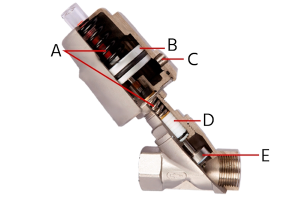
Figure 2: Section view of a pneumatic angle seat valve: spring return (A), piston (B), air port (C), packing (D), and plug/disc (E).
Key components of a pneumatic angle seat valve (Figure 2):
Spring return (A): Automatically resets when air pressure is relieved, restoring the valve to its initial state (open or closed).
Piston (B): As the core component of the pneumatic actuator, the piston produces linear motion under the action of air pressure, driving the spool to disengage or press the valve seat to realize the opening and closing of the valve.
Air port (C): As the input channel for compressed air, its structure directly affects the driving efficiency of the piston and ensures stable airflow delivery.
Packing (D): Dynamic sealing is formed between the moving parts and the valve body, which not only prevents the medium from leaking out, but also avoids the loss of compressed air, and guarantees the sealing of the system.
Plug (E): As the end part of flow control, it is driven by piston to realize the clutch with the valve seat, which directly determines the state of fluid on and off.
The head of the actuator supports 360° free rotation, which facilitates flexible adjustment of the air and ensures efficient air and wiring layout in limited space. The valve body is made of brass or stainless steel to ensure durability. Connections include threaded, clamped, and welded. In addition, there is an intuitive position indicator on the top of the piston, which can quickly identify the opening and closing status of the valve.
Electric angle seat valves
The electric actuator converts electrical energy into mechanical torque through a motor to drive the valve to realize precise opening and closing. Its built-in gearbox can amplify the torque output to ensure precise valve positioning. Integrated sensors and control circuits monitor the valve status in real-time and send position signals to the control system for automated adjustment. This design enables the actuator to respond quickly to commands and accurately control media flow.
Advantages and disadvantages of angle seat valves
Angle seat valves occupy an important position in the industrial field due to their excellent performance and wide applicability. However, in the actual selection, it is necessary to comprehensively consider the control accuracy requirements, installation conditions, maintenance convenience overall investment costs, and other key factors.
Advantages
1.Efficient Flow Characteristics: The straight-through flow path design of the angle seat valve ensures high flow rates while effectively reducing fluid resistance and pressure drop.
2.Excellent durability: With enhanced structural design, the valve performs well in high temperature, high viscosity and other harsh conditions, and its service life can reach more than 10 million operating cycles.
3.Wide range of media adaptability: applicable to all types of liquids, gases, steam, and corrosive media for precise control.
4.High-temperature resistance: special PTFE sealing material, up to 200 ℃ (392 ℉) can withstand the operating temperature.
Disadvantages
1.Structural Strength Requirements: Large actuators require highly loaded reset springs to counteract pressure fluctuations caused by the water hammer effect, and increased spring stiffness further increases the need for actuator specifications.
2.Operational and maintenance requirements: Strict adherence to the manufacturer’s installation and maintenance procedures is essential to ensure sealing performance and operational efficiency, but it also increases the workload of technical management.
3.Economic analysis: Although angle seat valves have a higher initial investment due to the use of reinforced construction and high-quality materials, they have long-term economic advantages over traditional ball or solenoid valves.
Applications
Angle seat valves are used in a wide range of industrial applications for fluid control due to their excellent operating efficiency, long-lasting durability, and broad media compatibility, and can be adapted to a wide variety of operating environments.
Food and beverage industry
Sterilization process: Adopt steam sterilization technology to ensure the hygiene and safety of food and beverage products and production equipment.
Filling control: Accurate flow regulation is realized in the container filling process, relying on the fast response characteristics of angle seat valves to ensure filling accuracy.
Fluid Management: Suitable for process control of water, steam, and other processing fluids to meet the diverse media control needs of food and beverage production.
Chemical industry
Dosage Metering: Precise control of chemical additive dosage during the reaction process ensures accurate proportioning of chemical components in the process stream.
Corrosion-resistant flow control: With a reinforced structural design, it can stably control the flow of corrosive and highly reactive chemical media, adapting to the requirements of operation in harsh chemical environments.
Oil and gas industry
Steam regulation: Excellent performance in high-temperature and high-pressure conditions such as steam driven oil, and its excellent temperature and pressure resistance ensures reliable steam flow management.
Process control: Effective isolation and precise regulation of gas and liquid phase media at all stages of oil and gas processing and refining.
Water and wastewater treatment
Sludge management: Optimized flow channel design prevents clogging and ensures stable regulation of slurry media flow in wastewater treatment systems.
Water Treatment Optimization: Provides precise flow control in filtration, disinfection and chemical dosing processes, significantly improving treatment system performance through reliable operation.
Pharmaceutical industry
Aseptic steam systems: play a key role in the sterilization of pharmaceutical equipment, their high-temperature resistance and sterility guarantee performance to meet the strict health standards.
Pharmaceutical Fluid Management: Provides precise control of fluids and gases in the pharmaceutical production process to ensure the quality of preparations and the stability of the production process.
Manufacturing and automation
Intelligent production line control: integrated into the automated production system, it accurately manages the medium delivery of compressed air, process water flow, etc., and significantly improves the automation level of the production line.
Temperature control system application: through precise adjustment of the cooling medium flow, to maintain constant temperature operation of the equipment, and effectively prevent the risk of thermal overload.
Heating, ventilation, and air conditioning (HVAC)
Steam Thermoregulation: Precise management of steam flow in heating systems, with excellent resistance to high temperatures and pressures to ensure efficient heat transfer.
Angle seat valve selection
End connections and line sizes
Specifications: BSP/NPT threads from 1/2“ to 3” are available, and some models support flange connection. Selection should focus on the seat DN and Kv (water flow at 1 bar differential pressure). It is recommended that a valve calculator be used to determine the minimum Kv requirement to optimize sealing performance and service life while maintaining flow efficiency.
Operating temperature, pressure, and material properties
Pressure and temperature parameters:
Operating pressure range: 5-20 bar (both medium pressure and gas line pressure must be checked).
Temperature tolerance:
PTFE seals: up to 200 °C (392 °F)
NBR/FKM/EPDM: for lower temperatures.
Material Selection:
Stainless steel: optimal corrosion resistance and strength (recommended for high-pressure and high-temperature service).
Bronze/Brass/Plastic: Suitable for normal conditions.
Selection recommendations: high pressure and high temperature conditions should be prioritized PTFE seals + stainless steel valve body combination configuration.
Valve installation and maintenance
Specification Installation:
Manufacturer’s specifications must be strictly adhered to.
Ensure that the orientation of the valve body is in line with the flow direction of the process.
Preventive Maintenance:
Establish a regular inspection program.
Focus on sealing performance and actuator condition.