
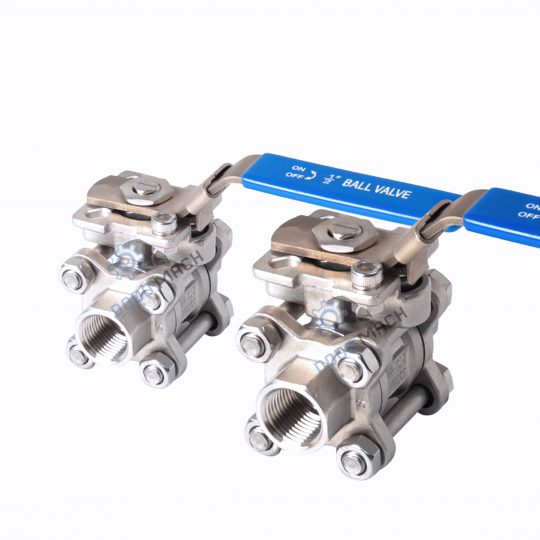
What is a Ball Valve and How do they work?
A ball valve is a flow control device that uses a hollow, perforated, and rotatable sphere to control the flow of fluid through it. When the hole in the center of the sphere is aligned with the fluid inlet, the ball valve opens; when the sphere is rotated 90 degrees by the valve handle, the ball valve closes, stopping the flow of fluid.
Ball valves are durable, hold up well after many cycles, and are reliable, closing safely even when not used for long periods. These characteristics make ball valves an excellent choice for shutoff and control applications where they are often preferred over gate and globe valves. However in throttling applications, ball valves lack the fine control of these alternatives.
Working Principle of Ball Valve
Open condition:
When the handle is rotated 90° to parallel with the pipe, the through-hole of the sphere is aligned with the pipe’s axis, and the fluid can pass through smoothly with minimal resistance (especially the full bore design).
Closed condition:
When the handle is rotated 90° to perpendicular to the pipe, the through-hole of the sphere is turned to a position perpendicular to the pipe axis. The solid part of the sphere blocks the flow path, relying on the sealing ring to realize the bidirectional sealing (both the upstream and downstream can be truncated).
Adjustment of flow rate (applicable to some models):
By controlling the angle of rotation of the handle (e.g., between 0° and 90°), the overlap area between the through hole and the flow path can be changed to realize flow adjustment (but most ball valves are designed for full open/full close, and long-term partial opening may damage the seal ring).
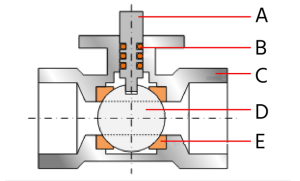
Figure 1
Understanding the five major components of a ball valve is critical to understanding how a ball valve works. The ball valve schematic in Figure 1 shows these five major components.
Stem (A): The stem connects the actuator (for example, a handle or an actuator (electric or pneumatic)) to the ball.
O-ring (B): The o-ring on the valve seat helps prevent leakage.
Shell (C): The shell supports all internal components of the valve and protects them from application and environmental conditions.
Ball (D): The ball has a hollow orifice through which fluid can flow when the valve is opening.
Seat (E): The seat supports and seals the ball components.
Circuit Function
According to the number of ports, ball valves can be categorized into different types such as two-way, three-way, four-way, etc., of which the two-way structure is the most common. These valves are usually operated manually with a lever, with the handle parallel to the pipe when opening and perpendicular to the pipe when closing.
The medium flow direction of 2-way ball valves is clear(Figure 2), always flowing from the inlet end to the outlet end. It should be noted that manual ball valves close faster, and there may be a risk of water strike in high-speed fluid systems so some products will be equipped with transmission devices.
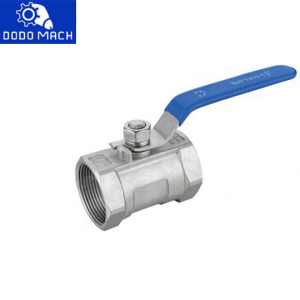
Figure 2
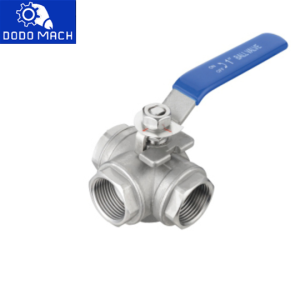
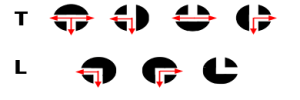
Figure 3
The design of the three-way ball valve is more complex, its spool channel can be presented in an L-shaped or T-shaped layout (shown in Figure 3), through a combination of different flow directions can be realized through the media shunt or mixing and other functions. As a special structure, its two ports are arranged at right angles, which is suitable for specific pipeline connection needs.
Housing assembly
There are three main types of body construction for ball valves, each with its own characteristics in terms of maintainability and application scenarios.
One-piece valve body:
- A pressing or welding process is used to fix the two parts of the ball body
- Simple structure and lowest cost
- is not removable for maintenance
- is suitable for less demanding applications
Two-piece valve body:
- uses threaded connection construction
- can be disassembled for cleaning and servicing
- Maintenance requires complete disassembly of the valve
- Cost-effective option
Three-piece valve body:
- High-end design with bolted connections
- Maintenance does not require complete disassembly of the valve
- Easy internal inspection and component replacement
- suitable for occasions requiring frequent maintenance
Although the three structures are assembled differently, the operation principle is the same. Users can choose the right type according to their budget and maintenance needs, among which the three-piece type is the most convenient for maintenance but the most costly, while the one-piece type is the most economical but unmaintainable.
Ball design
Ball valves can be categorized into two mainstream designs, floating type, and trunnion type, according to the internal structure. Floating structure, the ball is supported by both sides of the valve seat, this design is simple and reliable, suitable for most conventional conditions.
While trunnion type in the ball on the lower end of the additional mechanical support, especially suitable for large-diameter (DN> 100mm) and high-pressure (more than 30 bar) applications, can effectively reduce the load on the valve seat and reduce the operating torque.
In terms of flow path design, ball valves are mainly divided into three types:
- Reduced diameter type: the diameter of the flow path is smaller than the connecting pipeline, which will produce a certain pressure drop but the impact is small, this is the conventional choice of economical and practical
- full diameter type: flow path and pipe diameter, easy to clear the pipe operation and no additional resistance, but the size and cost of the valve are relatively high
- V-regulation type: using a special V-type opening, can realize precise flow regulation and linear flow characteristics.
Each design has its specific advantages and application scenarios, users can choose the right type according to the actual working conditions. The full bore type is suitable for piping systems that require pipe clearing, the V-type is suitable for processes that require flow regulation, and the standard reduction type offers good cost performance in most routine applications.
Ball Valve Handle
The operating mechanism of the ball valve adopts an intuitive 90-degree rotary design to realize quick opening and closing through the handle or handwheel. When the handle is parallel to the pipeline, the valve is open, and when it is perpendicular, it is closed. This simple and clear design makes it easy for the operator to quickly determine the status of the valve.
Depending on the needs of the application, several practical variants of the operating mechanism have been developed: lockable handles to hold the valve in position and prevent inadvertent operation; handwheels for fine adjustment; extension handles to provide additional operating torque for larger valves; and replacement handles to facilitate maintenance and retrofitting. These operating mechanisms all follow the same rotational principle but are optimized for specific operating conditions.
In practice, it is vital to ensure that the handles are correctly fitted, as incorrectly oriented mounting can lead to misclassification of the status. For applications where space is limited or frequent adjustments are required, it is recommended that a special handle with a locking function or adjustable length be used to improve operational efficiency and safety.
Ball valve shell material
The most common housing materials are brass and stainless steel. The ball is usually made of chrome-plated steel, chrome-plated brass, stainless steel, or PVC. The seat is usually made of Teflon but may be made of other synthetic materials or metal.
So how do you choose a ball valve housing material?
Brass ball valves(Figure 4):
1. good corrosion resistance 2. excellent processing performance 3. good sealing 4. lightweight, easy to install 5. economic price 6. good low-temperature adaptability BUT 1. lower strength, not resistant to high pressure 2. not resistant to strong acids and alkalis 3. temperature limitations 4. not suitable for high purity requirements occasions 5. environmental and health issues
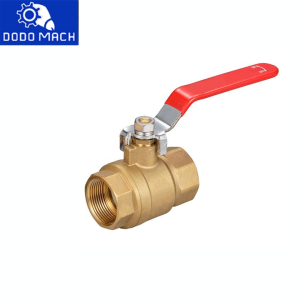
Figure 4
Stainless steel ball valve(Figure 5):
1. excellent corrosion resistance 2. high strength, high pressure, and high temperature 3. long life, low maintenance 4. sanitary design (for food, medicine) 5. adapt to extreme environments 6. environmentally friendly and lead-free BUT 1. higher cost 2. greater weight 3. some working conditions may corrode 4. processing difficulties 5. not suitable for all media
Figure 5
Ball Valve Connection Types
Ball valves are available in a variety of connection types that can be flexibly selected to meet the needs of different piping systems. The most common connection types include:
- Threaded connection: internal thread, external thread, or combined thread design, suitable for two-way, three-way, and four-way valve configuration. This compact connection is characterized by a simple structure and easy installation.
- Flange connection: docked with the piping system through a standardized flange, usually with a full bore design to ensure that the fluid throughput capacity. Flanged ball valves are particularly suited to industrial piping applications that require high flow rates to be delivered.
Each type of connection is designed to meet the needs of specific working conditions. Threaded connections emphasize economy and convenience, while flanged connections focus on system compatibility and flow efficiency.
At the end, if you have any questions about our pneumatic products, just feel free to contact us for more information.
You can view and learn more about our products through our official website.