

Introduction to Air Source Treatment and Its Advantages
The air source treatment(F.R.L) is an element that performs work through the pressure or the force generated by the expansion of the gas, that is, a mechanism that converts the elastic energy of the compressed air into kinetic energy. Including air filters, pressure regulators, lubricators, etc. Pneumatic products are widely used in automatic production in metallurgical electromechanical, construction, transportation equipment, home appliances, light industry, machine tools, medical care, packaging and other industries.
However, because the compressed air discharged by the air compressor cannot be used directly, the compressed air contains a certain amount of moisture, oil and dust. The temperature of the compressed air is as high as about 140-170 °C, and some of the water and oil have become gaseous. Therefore, it is necessary to use purified compressed air to run machinery and equipment.
Instructions of Air Source Treatment
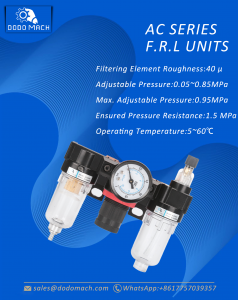
The composition of the air source treatment includes an air filter, a regulator and a lubricator. Some brands of solenoid valves and cylinders can achieve oil-free lubrication (relying on grease to achieve lubrication), so there is no need to use a lubricator. The filtration degree is generally 40-75μm, and the pressure regulation range is 0.05-0.85Mpa.
The assembly formed by connecting the pipes is called a triplet. The three major components are indispensable air source treatments in most pneumatic systems. They are installed near the air equipment and are the final guarantee for the quality of compressed air. The installation sequence of the three parts is air filter, regulator and lubricator according to the direction of intake air. The combination of the air filter and the regulator can be called a two-piece.
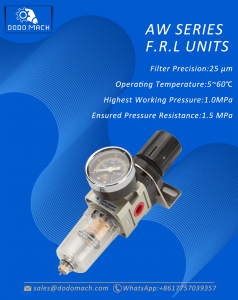
The air filter and the regulator can also be assembled together to become a filter & regulator (the function is the same as the combination of the air filter and the pressure reducing valve). In some occasions, oil mist cannot be allowed in the compressed air, and an oil mist separator needs to be used to filter out the oil mist in the compressed air. In short, these components can be selected according to needs, and they can be used in combination.
The air filter is used to clean the air source, which can filter the moisture in the compressed air and prevent the moisture from entering the device with the gas. The regulator can stabilize the air source and keep the air source in a constant state, which can reduce the damage to the valve or actuator and other hardware due to the sudden change of the air pressure of the air source. The lubricator can lubricate the parts that are inconvenient to add lubricating oil, which greatly prolongs the service life of the body.
- There are two ways of filter drainage: differential pressure drainage and manual drainage. Manual draining must be done before the water level reaches the level below the filter element.
- When adjusting the pressure, please pull up and then rotate before turning the knob, and press the knob for positioning. Turn the knob to the right to increase the outlet pressure, and to the left to decrease the outlet pressure. When adjusting the pressure, it should be gradually and evenly adjusted to the required pressure value, and should not be adjusted in one step.
- How to use the lubricator: The lubricator uses JIS K2213 oil (ISO Vg32 or the same grade oil). Please do not fill the cup more than eight points full.
Operational Requirements of Air Source Treatment
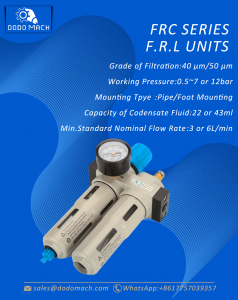
- Select the components required by the system according to the technical performance parameters such as pipeline diameter, flow rate, pressure regulation and filtration accuracy;
- Select the appropriate air filter according to the air quality requirements;
- When using a regulator, try to avoid using the lower limit of the regulator, and select a suitable regulatoraccording to the requirements of the operating pressure;
- Installation sequence: Starting from the inflow end of the air source, connect the air filter, regulator, and lubricator in sequence. The direction of the arrow on the component shell is the direction of the air flow and cannot be reversed;
- The air filter and lubricator must be installed vertically with the side with the cup facing down;
- Once the lubricator flows back, it will cause damage to internal parts and danger, so it should be avoided;
- When installing and connecting the air source treatment, avoid mixing impurities such as sealing tape and rust into the pipeline.
Advantages of Air Source Treatment
- The air source treatment has a simple structure, light weight, easy installation and maintenance. The medium is air, which is less flammable than hydraulic medium, so it is safe to use.
- The working medium is inexhaustible air, and the air itself does not cost money. The exhaust gas treatment is simple, does not pollute the environment, and has low cost.
- The adjustment of output force and working speed is very easy.
- High reliability and long service life.
- Using the compressibility of air, it can store energy and realize centralized air supply. The energy is released for a short period of time for high-speed response in intermittent motion. Buffering is possible. Strong adaptability to shock loads and overloads.
- The full pneumatic control has the ability of fireproof, explosion-proof and moisture-proof. Compared with the hydraulic method, the pneumatic method can be used in high temperature applications.
At the end, if you have any question about our air source treatments or other pneumatic products, just feel free to contact us for more information.
You can view and learn more about our products through our official website.