

How to Distinguish Thread Type?
Thread types are standardized to guarantee compatibility and ease of maintenance. To provide a secure joint connection in both new and current applications, the thread type must be determined.
Verify the following to locate a thread that is unknown:
Gender: male or female.Taper: a parallel or tapered shape. This can be confirmed either visually or by using a caliper to measure the thread diameter at both its beginning and its end.
Thread Diameter: Measure the minor diameter for female threads and the major diameter for male threads. Keep in mind that this diameter will never match the thread’s nominal size. Thread Pitch: A pitch gauge can be used for this. To confirm proper pitch, measure many samples. If a pitch gauge is not accessible, you can calculate your thread pitch in inches by counting the threads in a 1-inch span (TPI), the reciprocal is thread pitch in inches. Count the threads in a 10mm span if you have any doubts that the thread is metric. Your pitch size in millimeters is the reciprocal of this number.
Universal Thread Type Standards
British Standard Pipe (BSP)
Except for the United States, every country in the world has adopted the BSP, or Whitworth thread, family of thread standards. This thread form is built on a 55° V-thread with rounded roots and crests. For a thread that complies with BSP, the minor diameter of the pipe thread will be extremely near to (smaller than) the inside diameter of the female thread, and the major diameter will be somewhat smaller than the actual OD of the pipe.
BSP threads come in two varieties:
BSPP: The male and female threads are parallel, according to BSPP. In Asia, Europe, UK, Australia, New Zealand and also South Africa, BSPP thread type are frequently utilized.
BSPT: The female threads are typically parallel, and the male threads are tapered. In China and Japan, BSPT thread type are extremely common.
Each letter used to identify BSP threads stands for a different type of thread and the standards it is related with:
G: external and internal parallel (ISO 228, DIN 259) – BSPP
R: external taper (ISO 7, EN 10226, BS 21, JIS B 0203) – BSPT
Rp: Internal parallel (ISO 7-1, EN 10226) – BSPT
Rc: internal taper (ISO 7) – BSPT
Rs: external parallel (BS 21) – BSPT (Obsolete)
Pipe threads with pressure-tight couplings that conform to ISO 7. Pipe threads that are not turned into pressure-tight connections according to ISO 228. And each thread size is designated by a number that has little relation to the thread’s real size. Throughout the history of the standardization of pipe threads, changes in industrial processes and standardization are to cause for this variance. As a result, you should constantly compare measures to the sizes that are stated in the tables.
NP – National Pipe Thread Type (American)
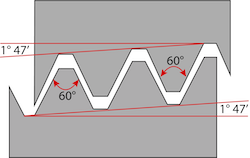
The American national pipe thread, which is extensively used in the United states and Canada, was developed based on a 60° V-thread with flattened peaks and valleys. NP threads come in two varieties:
NPS: Straight threads, meaning the male and female threads are parallel.
NPT: Tapered threads, meaning the male and female threads are tapered. NPT threads are more commonly used.
M – Metric Thread Type(ISO)

One of the first universally recognized thread types is the metric thread. Male and female threads are both parallel, and the V-shaped thread type has a flank angle of 60°. Metric Threads are available in coarse pitch and fine pitch sizes for a particular diameter. The default pitch size is for coarse threads, which are used more frequently and have smaller pitch sizes. Because of this, coarse threads are distinguished solely by diameter, but fine threads are distinguished by diameter and pitch size.
For a given diameter, metric threads are available in two different pitch sizes:
Coarse Pitch: These are the most widely used and have the standard pitch size. They follow ISO 724.
Fine Pitch: These have a lesser pitch size, and the labeling calls for the pitch size’s diameter. They follow ISO 724.
At the end, if you have any question about our pneumatic products, just feel free to contact us for more information.
You can view and learn more about our products through our official website.