

How Do Pneumatic Cylinder Mounting Accessories Work?
Accessories for pneumatic cylinders are used to mount or connect the cylinder to a load. Some accessories are interchangeable with any brand because they are part of ISO 6432 and ISO 15552. Nevertheless, if the mounting requirements are compatible, they can be utilized with cylinders that are not ISO. The functionality, dependability, and main structure of the system will be impacted by mounting accessories. The right mounting accessories can be chosen based on the system requirements as well as the desired function.
A pneumatic cylinder is a industrial tool that uses compressed air to transform energy into a linear movement. The two most popular international standards for interchangeability for pneumatic cylinders are ISO 6432 for micro round cylinders (diameters between 8 and 25 mm) and ISO 15552 for profile cylinders (diameters between 32 and 320 mm).
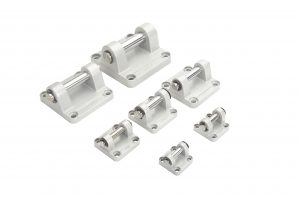
Cylinder installation methods
Fixed pivot mount, Fixed centerline mount and fixed offset mount are the three main cylinder mounting methods. The appropriate mounting attachment can be chosen based on the application and required function of the pneumatic cylinder.
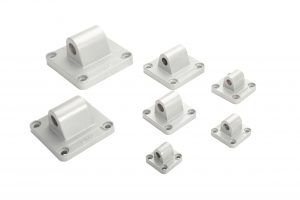
Fixed pivot mount
Pivot mount cylinders are fastened to a surface and can withstand forces applied along their centerline. One plane of alignment can be changed with fixed pivot installation. In order to prevent the cylinder rod from bending strains, pivot mount attachments are helpful for absorbing slight misalignment.
A pivot point is also provided by accessories like rod end attachments, which are frequently used in conjunction with pivot mountings. Although pivot mount cylinders allow for free movement, if the piston rod is not properly directed, bending loads will be placed on it. Clevis and trunnion are the two most typical methods of pivot mounting.
Fixed offset mounting type
As it is secured to a mounting surface and forces are absorbed along the center line of the cylinder, fixed offset mounting is comparable to fixed centerline mounting. The cylinder is, however, placed off-center at the cylinder’s sides or feet. Side mount and foot mount are the two most popular styles of offset mounting. It can be used to push or draw a weight and provides for the simplest assembly and disassembly.
However, a side load may be produced if the mounting is displaced from the line of force. In order to reduce the stress caused by shear stresses and maintain simple tension for the mounting bolts, the cylinder should be pinched or keyed. Because of the possibility of leaks and the cylinder’s increased propensity for movement with changing loads, rigid plumbing connections are not recommended.
Fixed centerline mounting type
The centerline of centerline mount cylinders, which are fastened to a surface, will withstand force. Applications where the weight is pushed or pulled along a linear route can make advantage of centerline mounting. This kind of installation will minimize side loads during actuation and distribute forces uniformly along mounting bolts. By lowering stress along the piston and rod bearings, this lowers the chance of misalignment and delays premature bearing failure. Centerline lugs, flanges, and tie rods are the three most used centerline mounting styles.
Rod-end spherical eye type accessories
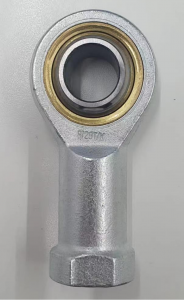
A rod-end spherical eye for pneumatic cylinders, which is used as a rod-end connection for load attachment, has mounting specifications that are specified by ISO 8139. Rod-end spherical eyes, also known as rod-end eyes, attach to a male-threaded piston rod using female threads. When coupling a load to the rod-end eye, a pin and clamp (also known as a clevis) are utilized.
For both linear (push or pull) and non-linear load travel, rod-end eyes are appropriate. Usually, a pin is used to secure this attachment to a female clevis attachment. As the piston rod exerts force on the load, the cylinder body is able to rotate. Unwanted forces might be applied to the piston rod and bearings if the force is not applied along the cylinder’s centerline because of misalignment. These accessories have the ability to tilt with cylinder motion to correct misalignment problems.
Rod-end clevis
The mounting specifications for rod-end clevises for pneumatic cylinders are specified in ISO 8140. Rod end forks are another name for rod-end clevis attachments. A male threaded piston rod is attached to by rod end forks using female threads. A pivot pin connects a load to the clevis attachment.
The use of linear (push or pull) and non-linear load travel is appropriate for rod-end clevis attachments. During actuation, a connection that rotates and maintains the force transfer along the centerline of the cylinder is provided by a rod-end clevis attachment. Applications where the load is pushed or dragged in a linear route can make use of spherical eye attachments.
Supplementary accessories
Floating joint:The floating joint accessories are attached to the load, which are then threaded into the rod end of the pneumatic cylinder. They allow for cylinder and driven body off-centering or loss of parallel precision. They typically have a range of rotational angles and a specification for linear variation. Due to the fact that other components (and installation) don’t require exact tolerances, installation time and cost can be lowered. They can be repeatedly used with tension and compression forces because to their compactness, simplicity, and rigidity.
Pin pivot:With another mount accessory or load coupling, pivot and centerline mount style attachments are connected using pivot pins.
Angle eye bracket:The cylinder can turn around its mounting surface thanks to an angle eye bracket that is connected by a pin to a female clevis installed on a cap.
Trunnion support:Trunnion brackets are firmly fixed in place and serve as a pivot for trunnion pins. In order to avoid misalignment and ensure smooth rotation around the trunnion pin, the bracket will serve as a guide.
At the end, if you have any question about our pneumatic cylinder accessories or other pneumatic products, just feel free to contact us for more information.
You can view and learn more about our products through our official website.