
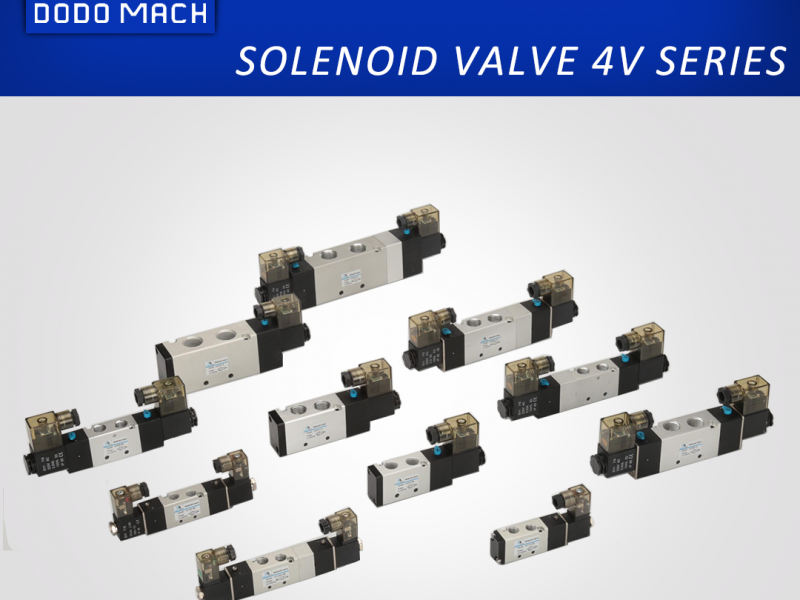
Strengths About 4V Series Solenoid Valve
Today let’s talk about our 4V SERIES solenoid valve products! If you are intersted, please read on.
About our 4V series products
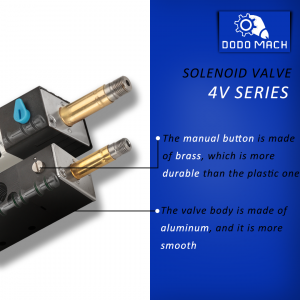
About the manual pin:
The manual pin can be made of brass and plastic, beyond all doubt that the brass type is more durable.
And the valve body is made of aluminum, it is more smooth than other manufactured valves.
About the coil:
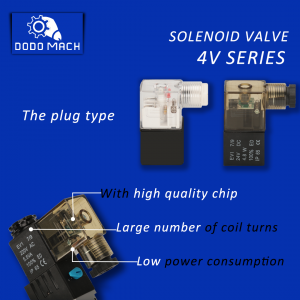
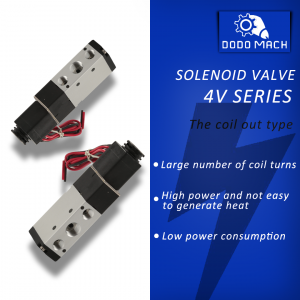
There are two types of coils for you to choose: the coil out type and the plug type. Both of them have a sufficient number of coil turns, and the plug type also contains high-quality chips, which makes the 4V solenoid valve faster and more stable, and prolongs the service life of the coil. Of course, both have high power and are not easy to generate heat, and the power consumption is relatively low.
About the spool:
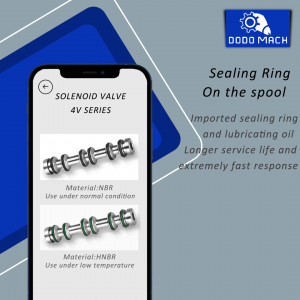
The sealing ring on the spool is divided into two materials. The black one is made of ordinary NBR material, that is used in normal environment. The green one is made of HNBR material, which is resistant to low temperature and will be used in low temperature environment.
In addition, we use imported sealing ring and lubricating oil to make its quality and performance better. So it has longer service life and extremely fast response.
About other parts:
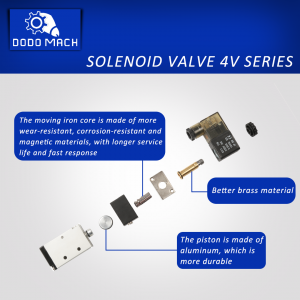
The moving iron core is made of more wear-resistant, corrosion-resistant and magnetic materials, with longer service life and fast response.
The piston is made of aluminum, which is more durable.
The pilot is made of better brass material.
About 4V valve’s working details
Normally the 4v series pilot-oriented solenoid valves operate slower than the direct-acting type. That’s because when air pressure is led through in and out of the pilot orifice, then the plunger in the valve will be pushed.
While the 4V solenoid valve is powered off, the core spring pushes it forward against the pilot base. So the core is used in order to seal against a little pressure port facing it, which will be opened when the solenoid is energized.
When the coil is turned on, the core is moved away from the pilot base, allowing the medium to enter the pilot. As long as the coil is active, this pulls the pilot against the spool, altering the valve’s airflow. When the valve is reset, the core spring pushes it against the pilot, sealing off airflow and opening the pilot’s exhaust ports, allowing the pilot to return to its idle position.
The manual pin is a feature found on several solenoid pilots. This is a little button on the outside of the pilot that manually pulls the core away from the pilot, allowing the marker to be fired. What’s more, a spring is used to reset the manual pin and keep it from interfering with the core during normal operating conditions.
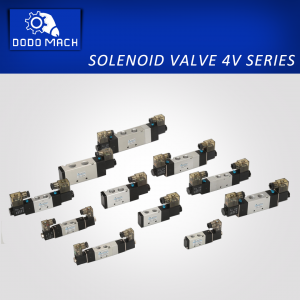
4V Solenoid valves are commonly used to control cylinders or to separate air passages. Spring reset is used in a single electrical control.
The five-position three-way solenoid valve is a double electronic control with no automatic reset function; its theory is virtually identical to that of the five-position two-way type, but it is in the middle position when the air stops (there is no air pressure in the intake). In general, there are three choices named middle seal, medium pressure and medium drain.
The positive-action coil of the double solenoid valve will be powered, and the positive-action gas circuit will be linked to it (or the positive-action outlet has the gas flow). Even if the positive-action coil is unplugged from power, the gas circuit is still powered and will remain so until the reverse-action solenoid valve is electrified.
The reverse-action gas circuit is linked to electricity if the reverse-action coil is turned on (or the reverse-action outlet has the gas flow). Even if the reverse-action coil is unplugged from power, the reverse-action gas circuit is still powered, and will remain so until the positive-action coil is electrified. This is analogous to the concept of “self-locking.”
The double electronic control, however, has a benefit over the single electronic control in that it does not require long-term power-on. The solenoid valve’s service life can be extended with just one short-pulse signal.
The 4V solenoid valve coil can move for one to two seconds during design of the electromechanical control circuit or compilation of the PLC, based on the aforesaid characteristic of the five-position two-way solenoid valve. This successfully guards against damage to the solenoid valve coil.
Finally, if you want to know more details about how does solenoid valve work, you can click this link to view.
If you have any question about these or other pneumatic components, please feel free to contact us.