
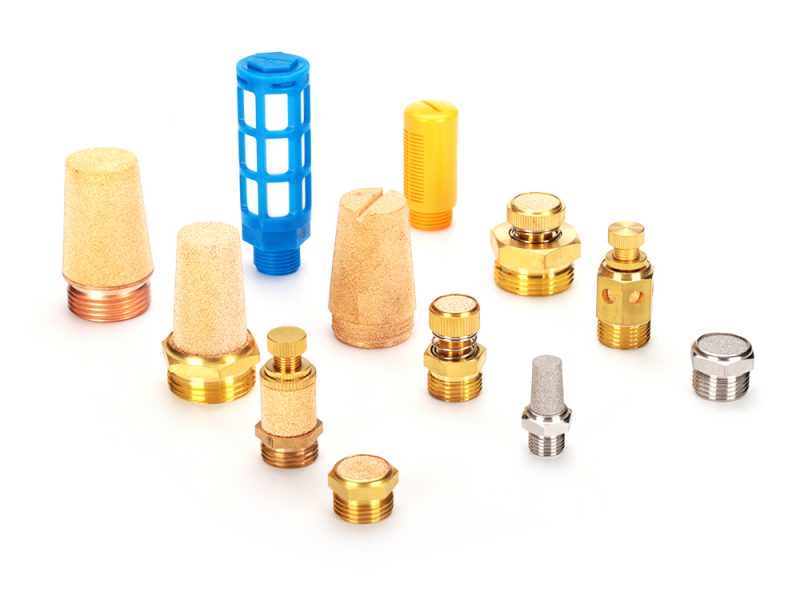
What is The Pneumatic Silencer or Muffler?
A pneumatic silencer is also named pneumatic muffler. It safely and quietly vents pressurized air to the atmosphere. They are usually installed on solenoid valves, pneumatic cylinders, manifolds and fittings. Without a silencer or muffler, the air exhausted from various types of pneumatic equipments can be so loud that it is harmful to the surrounding environment and can injure workers. Governments enforce standards set by organizations like OSHA to safeguard workers from harmful noise and pollutant exposure.
The pneumatic silencer is an easy and cost-effective way to reduce pneumatic noise and undesirable pollutants discharge. Adjustable throttle valves can be found in silencers to modify the rate at which air escapes the device. Flow rate control with a silencer throttle valve, which works similarly to a needle valve, can be beneficial for controlling the speed of a driving device. A throttle valve, for example, is often used to control the piston actuation and/or retraction speed in pneumatic cylinders.
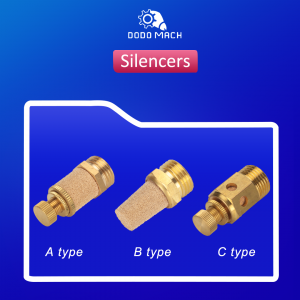
Specifications
Plastic or metallic materials such as brass and stainless steel can be used to make mufflers. Depending on the application, different versions are available. Cone, flat-face, and cylindrical shapes are all common design styles.
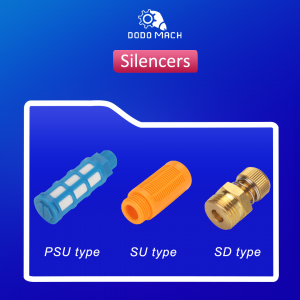
Plastic noise-reducing units often have injected-molded bodies with plastic fibers, sintered plastic, or metal powder inside. They’re usually less expensive, lighter, and have superior chemical resistance and noise reduction than comparable metal items.
Machined metal bodies with sintered bronze powder or compacted metal wool as the silencing substance are common in general-purpose brass items. They can withstand temperatures of up to 150 degrees Celsius.
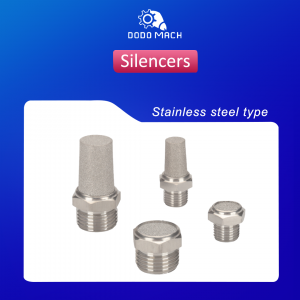
Silencers made of stainless steel feature a metal base covered in sintered stainless powder, wires, or woven mesh. The maximum working temperature is roughly 205 degrees Celsius. They’re ideal for applications that require corrosion resistance, durability, or operation in sterile or washdown environments. They are, predictably, more expensive than metal or plastic equipment.
The sizes range from less than 0.125 inch (3 mm) to more than 2 inch (50 mm). Allowable pressure range, connector size and type must all fulfill the clients’ specifications.
The effect the device will have on airflow is the most significant factor when installing pneumatic silencers. Due to back pressure caused by undersizing or clogging with pollutants, any considerable restriction will lower the compressed air circuit’s working capability. As a result, correct selection and maintenance are critical. Choose a unit with increased flow capacity if your application is particularly sensitive to back pressure.
A threaded male end is used to attach pneumatic silencers to ports. The ports can be used on a solenoid valve, an air cylinder and so on. NPT (National American Pipe Thread), BSP (British Standard Pipe), and metric thread standards are commonly employed (ISO standards). A push-in silencer can be simply transferred from one device or hose to another.
How does a pneumatic silencer work?
Acoustic power is a function of air density, turbulence, and, in particular, velocity, which has an exponential effect on noise creation (V6). Reduced pressure has little effect on noise abatement above about 2 bar. When turbulent, fast-moving air exits a port and collides with static air, noise is produced. Pneumatic exhaust that has not been suppressed can be called an air jet. In most industrial settings, airflow departs via an orifice at a constant velocity, causing noise due to the choking effect of the port and velocity.
Application
Pneumatic silencers can be used in a variety of situations. Pneumatic silencers are ideal for applications that use pneumatics at a high frequency and generate a lot of noise. Pneumatic silencers are often used in the applications listed below.
Packing:Pneumatics are frequently utilized to drive motion on packing equipment. A signal from an industrial control system will frequently cause a sorting machine to reroute product. The control system’s signal is utilized to activate a pneumatic device. Pneumatic silencers are well suited for packaging machines due to the high rate at which they run and the great number of people that are generally present around them.
Pneumatic cylinders are commonly used in machines which make fence rolls to cut the fencing. An operator works beside the machine must need to ensure that the rolls of fence meet the specifications. A pneumatic silencer is an excellent way to protect personnel from constant and detrimental noise.
At the end, if you have any question about our pneumatic silencers or other pneumatic products, just feel free to contact us for more information.
You can view and learn more about our products through our official website.