
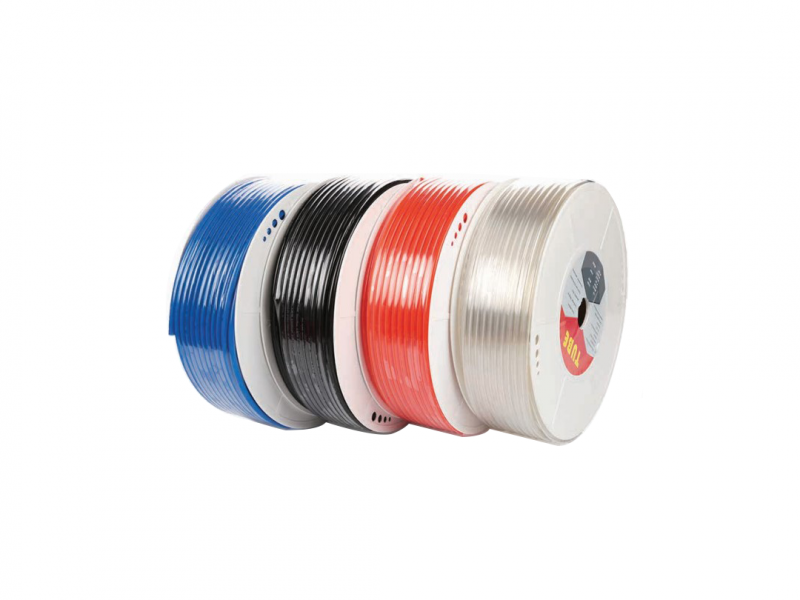
Guidelines for Pneumatic Tubing and Hose
Pneumatic tubing and hose‘s primary use is to deliver compressed air to valves, actuators, tools, and other equipments. Engineers should take into account a number of crucial considerations when choosing the appropriate tubing or hose for a particular work because there are lots of types and sizes of tubing and hose available.
Let’s talk about the structure of tubing and hose. For greater strength, air application tubes can be internally reinforced, generally with textile fibers, or extruded from a single material. An inner tube, one or more layers of reinforcing braided or spiral-wound fiber, and an external protective cover make up pneumatic hose in most cases. In general, hose is more durable than tubing, but it is more expensive.
The application and air supply create a baseline for the required product performance. The size of the hose or tube is determined by the required flow. Hose is often specified by ID, while tubing is typically given by OD and wall thickness. Choosing an inner diameter that is too small, however, media flow will be reduced and causes pressure losses, inefficiency, and excessive fluid velocity, all of which can reduce service life. On the other hand, a diameter that is too large leads to greater than necessary size, weight, and expense.
About material
Thermoplastics make up the majority of pneumatic tubing and hosing. They can be monolayer or multilayer, as was mentioned, depending on the application. The most popular thermoplastics used specifically for pneumatic tubing are briefly discussed here.
Engineers should evaluate the characteristics, advantages, and disadvantages of each material. The compatibility of the fluids transported through the conduit is a crucial aspect. For instance, in the case of air systems, the inner tube may be impacted by fumes from air lubricators, oil from air lubricators, or other chemicals consumed by the compressor.
Also, keep in mind environmental exposure from the outside. Chemicals, salt water, ozone, UV rays, harmful emissions, and other things can harm hose and tubing assemblies, causing deterioration and early failure.
Polyurethane (PUR or PU): Kink and abrasion resistant, flexible, and strong.
Polyamide (PA or Nylon): Light, robust, dimensionally stable, good bend radius, good flexural-fatigue resistance, and a low moisture absorption rate.
Polyethylene (PE): Flexible, good chemical resistance, and is cost-effective.
Polyvinylchloride (PVC): Light, flexible, and can be repeatedly sterilized with no ill effects.
Polypropylene (PP): Very light, good chemical and heat resistance, and has good surface hardness.
Pneumatic air supply
Flexible tubing or hoses are often used to link pneumatic components like cylinders, valves or pressure regulators to the primary air supply line. They can also be strengthened, like a metal-plastic pipe, to make them more durable while still being lightweight and flexible. A flexible hose will take this into consideration because the components may be vibrating or moving, so flexibility is crucial.
They may have the smallest required diameter because they are also near the conclusion of the pneumatic cycle. Through fittings, they are linked to both the primary air supply line and specific parts. Please read our article on fittings to learn how to choose a fitting. Barbed, compression, and push-in fittings are examples of common fittings.
Industrial pipework
It is frequently necessary to have many connections throughout large industrial workshops in order to link pneumatic tools. A rigid pipe system is typically employed in these circumstances because it provides protection against unintentional impacts or punctures. But installing these rigid pipe systems is costly and time-consuming. A lot of times, stiff PVC, aluminum, copper, and stainless steel are employed since durability is a crucial factor.
Additionally, they call for a lot of fittings and joints, which raises the risk of leaks. The temperature of the surrounding area must also be taken into account because pipes might expand and contract as a result of temperature changes. Aluminum, for instance, expands 0.24 mm per meter pipe with every 10°C rise in temperature.
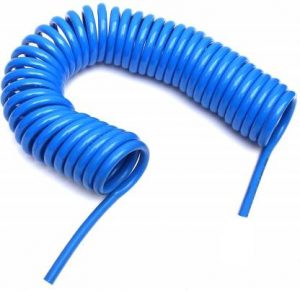
Spring tubing or hoses
In garages and workshops, spring hoses are frequently used to feed air to pneumatic tools like blast guns and impact wrenches. They don’t take up a lot of room because they are compact and light. Most of the time, the hose is not completely wound up to the fittings. A short, straight portion, known as a tail, is still present on both sides. The coil diameter affects the variation in length between the expanded and retracted states.
For a typical coiled air hose, the extended length might be, for instance, ten times the length when it is collapsed. The hose material must have a good elastic memory to return to its original coiled configuration after being straightened in order to create a spring air hose.
At the end, if you have any question about our pneumatic tubing or other pneumatic products, just feel free to contact us for more information.
You can view and learn more about our products through our official website.